If your business is constantly dealing with IT issues, slow systems, or unexpected downtime, you’re not just losing productivity, you’re losing revenue.
This is exactly where MSP servicing comes in.
But here’s the problem: most businesses hear terms like MSP services or managed service provider and assume it’s just “outsourced IT support.” That’s not only incomplete, it’s costing them opportunities to scale efficiently.
Let’s break it down clearly.
What is an MSP Managed Service Provider?
A Managed Service Provider (MSP) is a company that proactively manages your IT infrastructure, systems, and digital operations, so you don’t have to react to problems after they happen.
Simple definition:
An MSP doesn’t just fix issues.
It prevents them, optimizes your systems, and aligns your technology with your business goals.
Instead of hiring an in-house IT team (which is expensive and limited), businesses use MSP services to get:
- Continuous monitoring
- Cybersecurity protection
- System optimization
- Technical support
- Strategic IT planning
And most importantly, predictable performance.
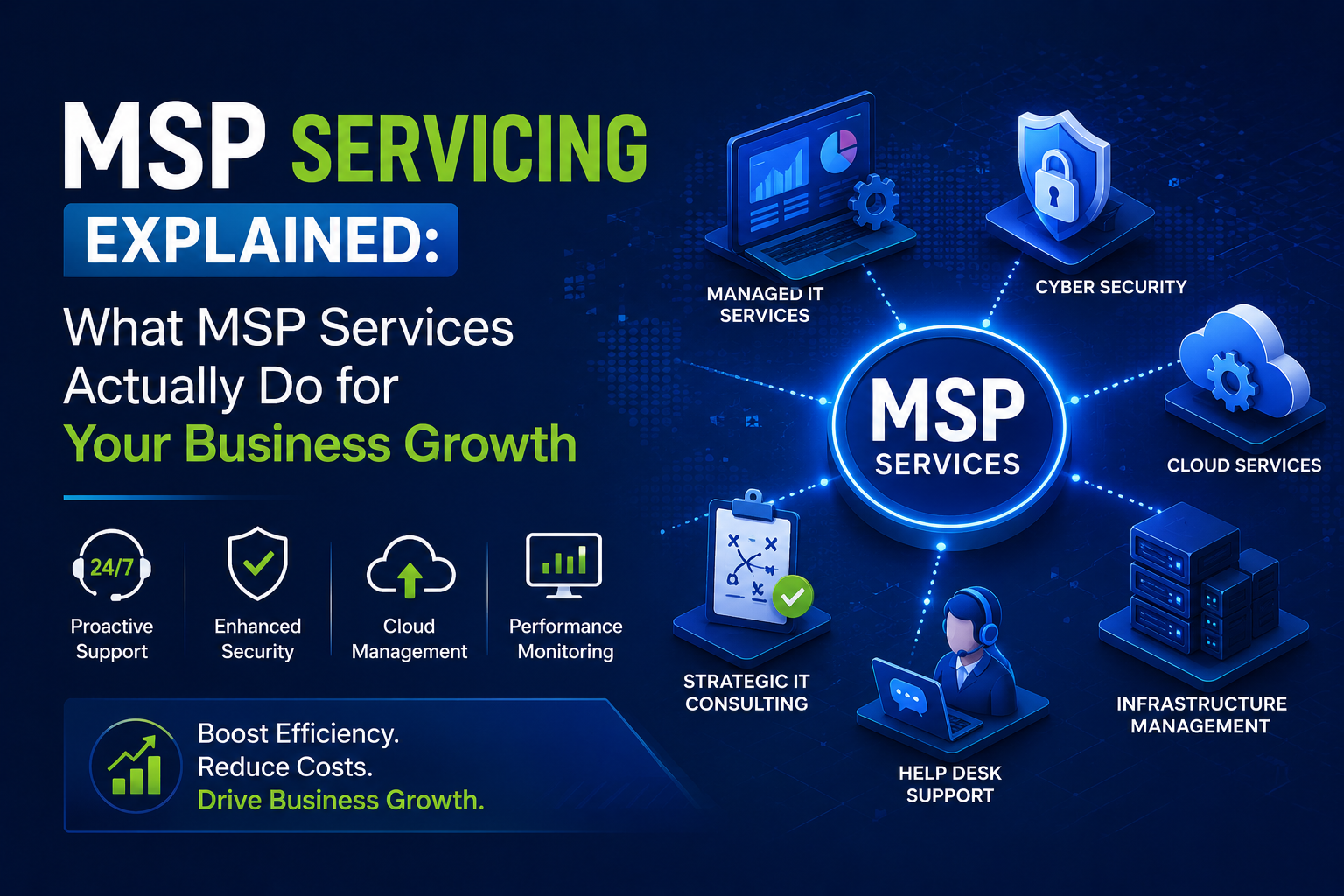
What Does MSP Servicing Actually Include?
Not all MSP servicing is equal. High-quality MSP services go beyond basic IT support and focus on business outcomes.
Here’s what effective MSP servicing typically includes:
1. Proactive Monitoring & Maintenance
Your systems are monitored 24/7 to detect issues before they become problems.
Why it matters:
Downtime is expensive. Preventing it is far cheaper than fixing it.
2. Cybersecurity Management
From firewalls to endpoint protection, MSPs ensure your business stays protected against evolving threats.
Insight:
Cyberattacks are no longer targeting just large enterprises, small and mid-sized businesses are now primary targets due to weaker defenses.
3. Data Backup & Recovery
Reliable backups and quick recovery systems ensure your business can continue even after data loss incidents.
Why it matters:
One data failure without backup can shut down operations entirely.
4. Cloud Services & Optimization
MSPs help manage cloud infrastructure, ensuring scalability, performance, and cost-efficiency.
Real advantage:
You only pay for what you use, while still having enterprise-level flexibility.
5. Helpdesk & Technical Support
Quick resolution of day-to-day technical issues for your team.
Hidden benefit:
Your employees stay focused on work instead of wasting hours on IT problems.
6. IT Strategy & Consulting
This is where real growth happens.
A strong MSP doesn’t just maintain your systems; it aligns your tech with your business goals.
Why Businesses Are Moving Toward MSP Services
Most businesses don’t switch to MSP services because they want to; they switch because their current setup stops working.
Here are the real reasons behind the shift:
❌ Reactive IT is too slow
Fixing issues after they happen leads to downtime, frustration, and lost revenue.
❌ In-house teams are expensive
Hiring, training, and retaining IT staff is costly, and often limited in expertise.
❌ Technology is evolving too fast
From cloud to cybersecurity, keeping up internally is nearly impossible.
✅ MSP servicing solves all three
It gives you:
- Faster issue resolution
- Access to a full team of experts
- Scalable technology support
Without the overhead.
MSP Servicing vs Traditional IT Support
This is where most businesses misunderstand the value.
| Traditional IT Support | MSP Services |
|---|---|
| Fixes issues after they happen | Prevents issues before they happen |
| Paid per incident | Fixed monthly cost |
| Limited scope | End-to-end management |
| No long-term strategy | Business-aligned IT planning |
Key takeaway:
Traditional IT keeps your business running.
MSP servicing helps your business grow.
How MSP Services Directly Impact Revenue
This is the part most providers fail to explain clearly.
MSP services are not just a cost-saving tool; they are a revenue enabler.
1. Reduced Downtime = More Billable Hours
Even a few hours of downtime per month can cost thousands.
2. Faster Systems = Higher Productivity
Optimized systems mean your team gets more done in less time.
3. Better Security = No Financial Loss from Attacks
A single cyberattack can cost more than a year of MSP servicing.
4. Scalable Infrastructure = Faster Growth
You can expand without worrying about IT limitations.
Who Needs an MSP Managed Service Provider?
MSP services are not just for large enterprises.
They are most valuable for:
- Small to mid-sized businesses scaling operations
- Companies without a dedicated IT team
- Businesses facing frequent technical disruptions
- Organizations handling sensitive customer data
- Growth-stage companies needing reliable systems
If your business depends on technology (which it does), MSP servicing is no longer optional—it’s foundational.
How to Choose the Right MSP Services
Not all MSP providers deliver real value. Many focus only on support, not growth.
Here’s what to look for:
✔ Proactive approach (not reactive)
They should prevent issues—not just fix them.
✔ Clear communication
You should understand what they’re doing and why.
✔ Business understanding
They should align IT decisions with your revenue goals.
✔ Scalable solutions
Their services should grow as your business grows.
Final Thoughts: MSP Servicing is a Growth Decision, Not Just an IT Decision
If you’re still thinking of MSP services as “outsourced IT,” you’re missing the bigger picture.
A strong MSP managed service provider:
- Reduces risk
- Improves efficiency
- Supports scaling
- Protects your business
- And ultimately, it helps you grow faster
The real question is no longer “Do you need MSP services?”
It’s:
“How much is your current IT setup costing your growth?”
If you’re planning to restructure your systems, optimize performance, or remove operational bottlenecks, MSP servicing is one of the highest-leverage decisions you can make.
And the earlier you implement it, the bigger the advantage.
Leave a Reply